
Introducing Exponent Risk-Tranching – Principal Protection for DeFi and RWAs
Introducing Exponent Risk-Tranching – Principal Protection for DeFi and RWAs

Exponent
News

A new, safer yield ecosystem is here.
Today we're introducing Exponent Risk-Tranching, principal protection for Solana DeFi and RWAs.
It launches with OnRe's ONyc as the first Risk-Tranching market, and the beginning of a new standard for how onchain yield asset risk can be priced and transferred.
Protection Has Been the Missing Piece for Onchain Finance
DeFi is making finance accessible to anyone. Yet one critical piece has been hindering its growth: protection.
After reaching billions in TVL and seeing rapid growth from yielding RWAs, the ecosystem has reached a plateau. For new capital such as institutions, the inability to protect invested principal remains a barrier to entering onchain finance and its opportunities.
Every new yield asset also brings a new risk profile. Some participants are comfortable taking raw exposure to that risk. Others are not. Many allocators want access to the yield, but do not want to sit directly in the first-loss position of the asset.
How can risk be properly priced and protected across every yield asset coming onchain? Exponent Risk-Tranching is our answer to that.
A New Standard for Solana DeFi
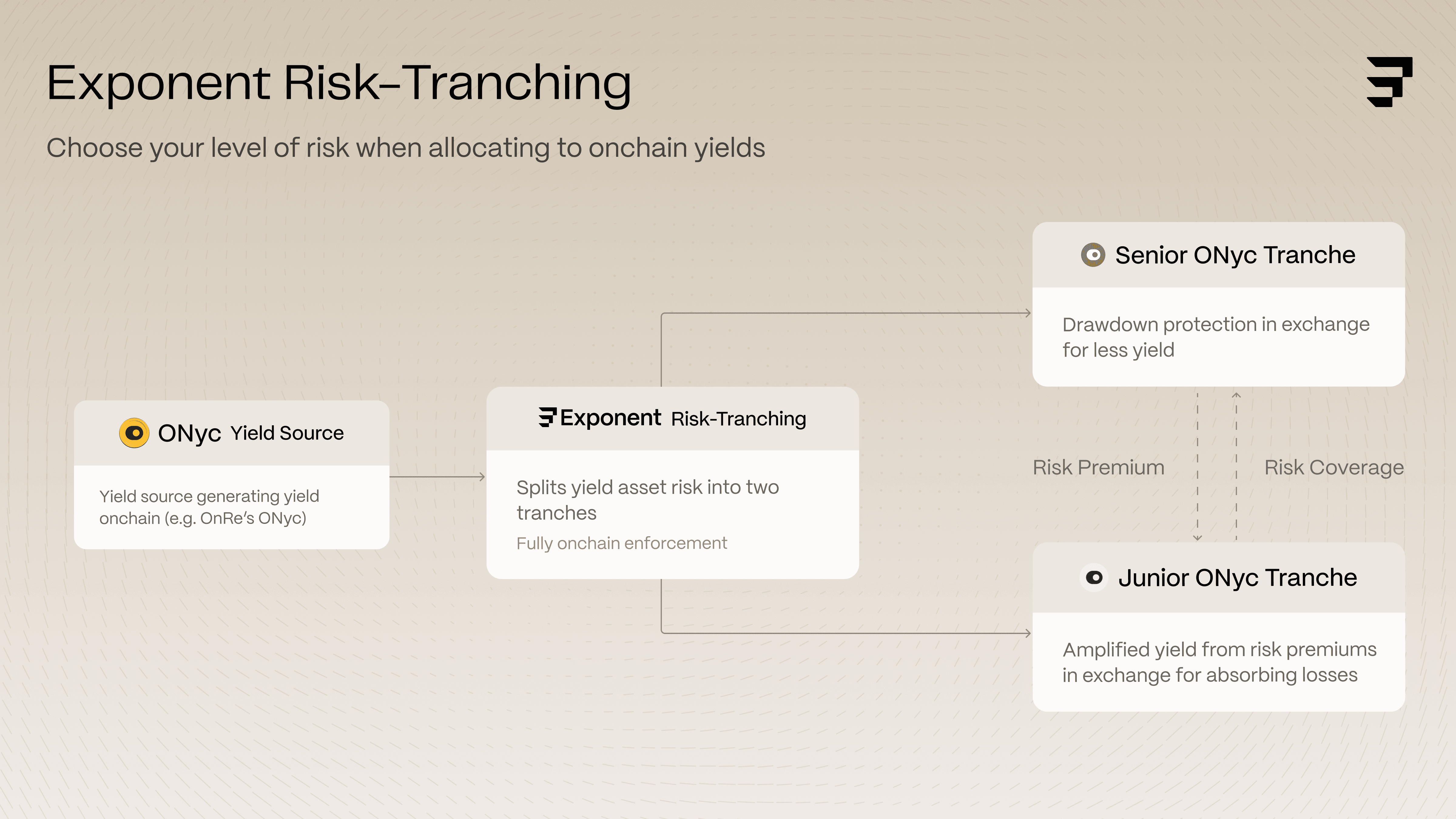
Exponent Risk-Tranching is a simple concept inspired by traditional finance: take a yield product and split it into two tranches to price and transfer its risk.
Conservative users can pay a yield premium in exchange for principal protection
Yield-seeking users can provide that protection in exchange for higher returns
This gives DeFi participants a new degree of choice. Instead of every user being forced into the same raw asset exposure, they can now choose the level of risk they want to take when allocating to yield assets.
One underlying yield asset can now support different capital profiles:
users looking for more protected exposure
users looking for amplified yield in exchange for taking first-loss risk
and, over time, institutional allocators that need more defined protection before deploying capital onchain
Why Exponent Is the Right Place for This
No platform is better positioned to bring risk-tranching onchain. Exponent has already become one of the key places where new yield assets come to market on Solana.
Coupled with Exponent's yield exchange, onchain participants can now access a complete platform to:
lock rates
trade variable yield
get principal protection
increase exposure to yield returns
Risk-Tranching is a natural extension to active management for DeFi portfolios, and add the missing component to support any yield market available onchain.
How Exponent Risk-Tranching Works
Each Tranching market operates on a utilization-based model:
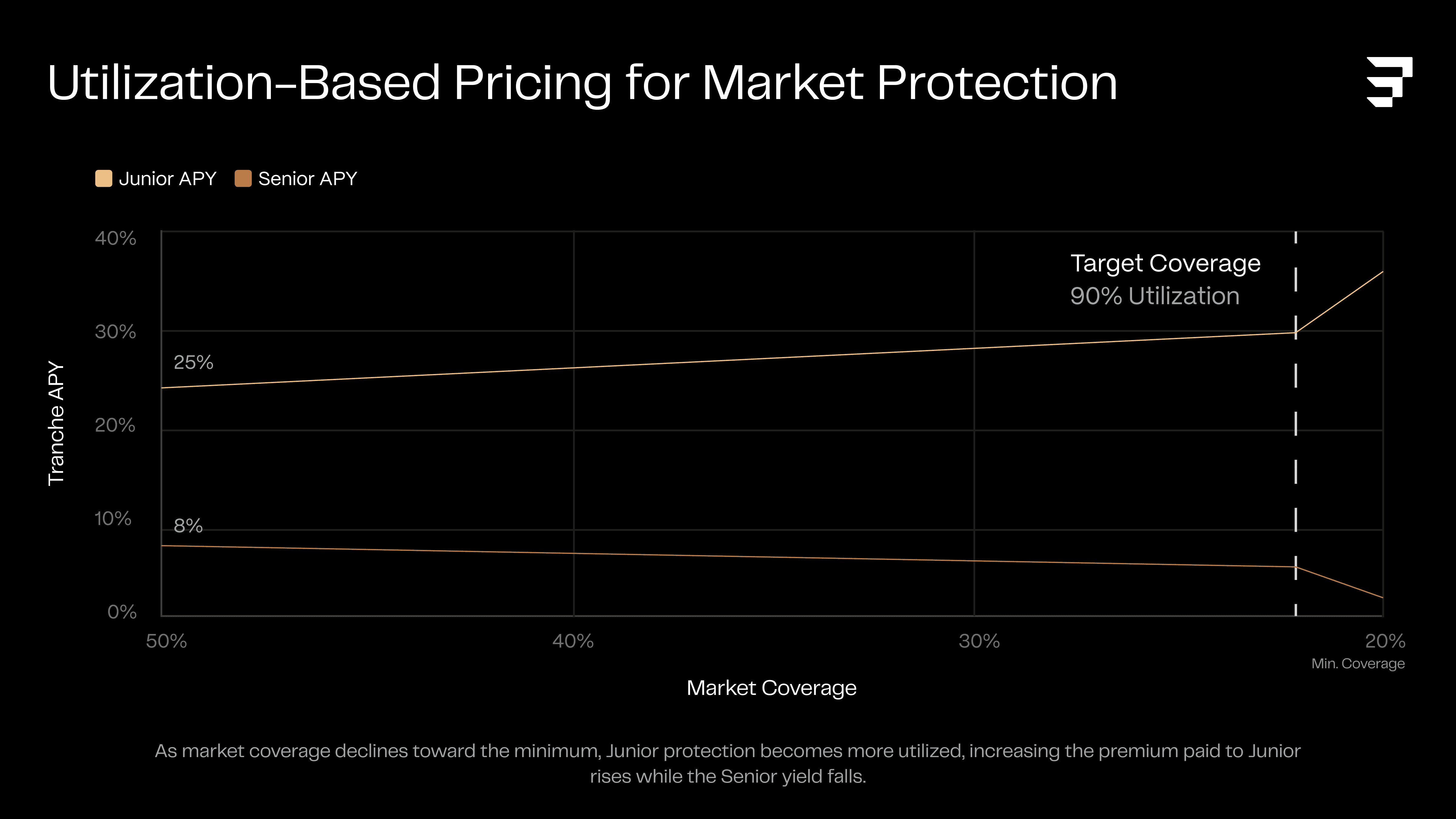
Rather than relying on fixed parameters and assumptions, protection is priced by market demand, with a minimum principal coverage level defined for each market. This allows the market to determine the real price, in yield terms, of risk for any asset.
As more Junior capital is used to protect Senior, the premium paid for that protection increases. As protection becomes more available, that premium compresses. The result is a market-driven way to transfer and price downside protection around a yield-bearing asset.
At a high level, each market creates two sides:
Senior Tranche: Users in the Senior tranche receive a more protected form of exposure to the underlying asset. In exchange for that protection, they give up part of the asset’s yield.
Junior Tranche: Users in the Junior tranche provide that protection. They absorb first losses before Senior and earn a higher premium for doing so.
This makes risk a live market outcome rather than a fixed assumption, where protection is not manually priced. Instead, it'ss priced by the capital willing to provide it and the capital willing to pay for it.
The First Live Market: ONyc from OnRe
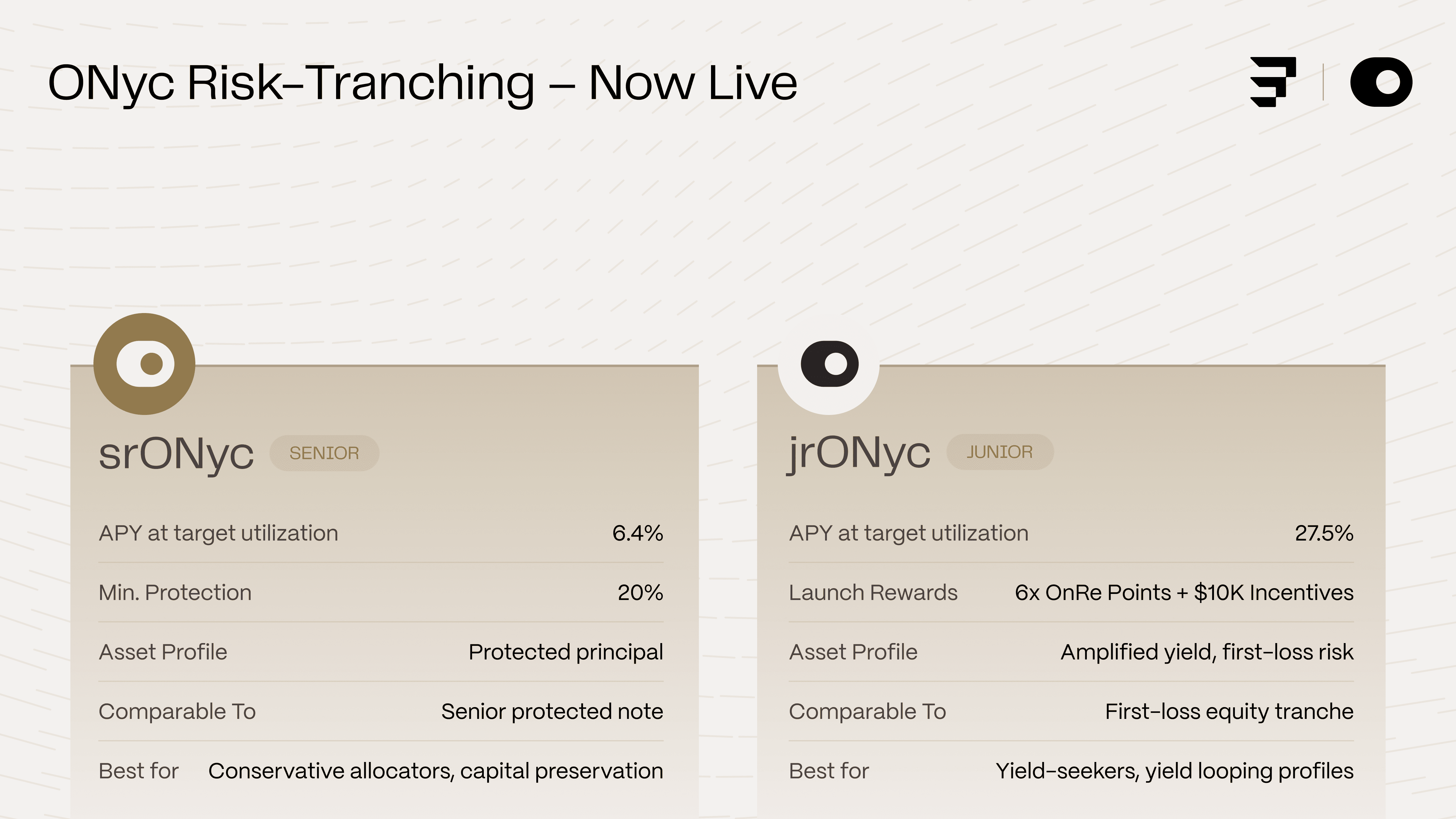
The first Exponent Risk-Tranching market is now live with ONyc from OnRe.
ONyc is a strong first asset for Risk-Tranching, already sitting at the intersection of multiple themes shaping the next phase of DeFi:
uncorrelated real yield
RWA yield from reinsurance premiums
growing demand from more sophisticated capital profiles
Participants can now allocate toward ONyc based on their risk profile through two tranches:
srONyc (Senior Tranche)
Get a minimum principal protection of 20% in exchange for less yield
Current target APY: 6.4%
jrONyc (Junior Tranche)
Take on more risk by providing protection and get amplified yield
Current target APY: 27.5%
This creates two very different ways to access the same underlying yield asset: a more protected profile through srONyc; a higher-risk, higher-return profile through jrONyc.
Which Tranche Should You Choose?
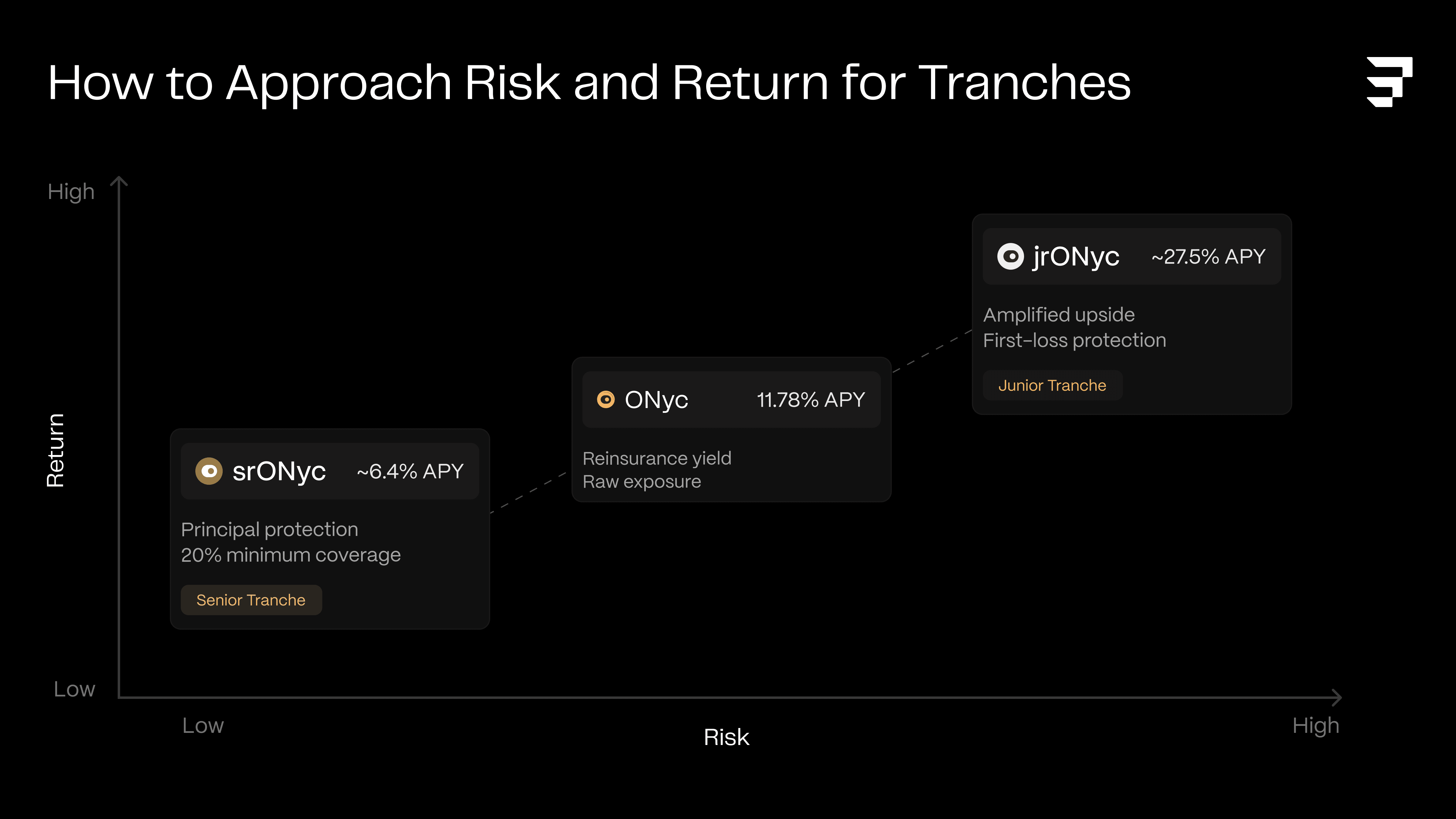
Hold srONyc if:
Principal protection matters most
Lower NAV volatility is preferred
A more protected way to access ONyc is the goal
Hold jrONyc if:
Higher yield is the priority
Additional risk is acceptable
Providing protection in exchange for amplified returns is attractive
The goal of Risk-Tranching is not to tell market participants which side is better, but to give the ability to choose the side that actually matches their profile and strategy.
A New Unlock for Portfolio Construction in DeFi
Phase 1 starts now with a $2.5M initial cap for the ONyc market.
We are excited to kick off a new era for DeFi markets. The next generation of onchain finance has to serve every risk profile, from conservative participants to yield seekers and institutions alike.
Learn more:
To go deeper on Exponent Risk-Tranching:
A new, safer yield ecosystem is here.
Today we're introducing Exponent Risk-Tranching, principal protection for Solana DeFi and RWAs.
It launches with OnRe's ONyc as the first Risk-Tranching market, and the beginning of a new standard for how onchain yield asset risk can be priced and transferred.
Protection Has Been the Missing Piece for Onchain Finance
DeFi is making finance accessible to anyone. Yet one critical piece has been hindering its growth: protection.
After reaching billions in TVL and seeing rapid growth from yielding RWAs, the ecosystem has reached a plateau. For new capital such as institutions, the inability to protect invested principal remains a barrier to entering onchain finance and its opportunities.
Every new yield asset also brings a new risk profile. Some participants are comfortable taking raw exposure to that risk. Others are not. Many allocators want access to the yield, but do not want to sit directly in the first-loss position of the asset.
How can risk be properly priced and protected across every yield asset coming onchain? Exponent Risk-Tranching is our answer to that.
A New Standard for Solana DeFi
Exponent Risk-Tranching is a simple concept inspired by traditional finance: take a yield product and split it into two tranches to price and transfer its risk.
Conservative users can pay a yield premium in exchange for principal protection
Yield-seeking users can provide that protection in exchange for higher returns
This gives DeFi participants a new degree of choice. Instead of every user being forced into the same raw asset exposure, they can now choose the level of risk they want to take when allocating to yield assets.
One underlying yield asset can now support different capital profiles:
users looking for more protected exposure
users looking for amplified yield in exchange for taking first-loss risk
and, over time, institutional allocators that need more defined protection before deploying capital onchain
Why Exponent Is the Right Place for This
No platform is better positioned to bring risk-tranching onchain. Exponent has already become one of the key places where new yield assets come to market on Solana.
Coupled with Exponent's yield exchange, onchain participants can now access a complete platform to:
lock rates
trade variable yield
get principal protection
increase exposure to yield returns
Risk-Tranching is a natural extension to active management for DeFi portfolios, and add the missing component to support any yield market available onchain.
How Exponent Risk-Tranching Works
Each Tranching market operates on a utilization-based model:
Rather than relying on fixed parameters and assumptions, protection is priced by market demand, with a minimum principal coverage level defined for each market. This allows the market to determine the real price, in yield terms, of risk for any asset.
As more Junior capital is used to protect Senior, the premium paid for that protection increases. As protection becomes more available, that premium compresses. The result is a market-driven way to transfer and price downside protection around a yield-bearing asset.
At a high level, each market creates two sides:
Senior Tranche: Users in the Senior tranche receive a more protected form of exposure to the underlying asset. In exchange for that protection, they give up part of the asset’s yield.
Junior Tranche: Users in the Junior tranche provide that protection. They absorb first losses before Senior and earn a higher premium for doing so.
This makes risk a live market outcome rather than a fixed assumption, where protection is not manually priced. Instead, it'ss priced by the capital willing to provide it and the capital willing to pay for it.
The First Live Market: ONyc from OnRe
The first Exponent Risk-Tranching market is now live with ONyc from OnRe.
ONyc is a strong first asset for Risk-Tranching, already sitting at the intersection of multiple themes shaping the next phase of DeFi:
uncorrelated real yield
RWA yield from reinsurance premiums
growing demand from more sophisticated capital profiles
Participants can now allocate toward ONyc based on their risk profile through two tranches:
srONyc (Senior Tranche)
Get a minimum principal protection of 20% in exchange for less yield
Current target APY: 6.4%
jrONyc (Junior Tranche)
Take on more risk by providing protection and get amplified yield
Current target APY: 27.5%
This creates two very different ways to access the same underlying yield asset: a more protected profile through srONyc; a higher-risk, higher-return profile through jrONyc.
Which Tranche Should You Choose?
Hold srONyc if:
Principal protection matters most
Lower NAV volatility is preferred
A more protected way to access ONyc is the goal
Hold jrONyc if:
Higher yield is the priority
Additional risk is acceptable
Providing protection in exchange for amplified returns is attractive
The goal of Risk-Tranching is not to tell market participants which side is better, but to give the ability to choose the side that actually matches their profile and strategy.
A New Unlock for Portfolio Construction in DeFi
Phase 1 starts now with a $2.5M initial cap for the ONyc market.
We are excited to kick off a new era for DeFi markets. The next generation of onchain finance has to serve every risk profile, from conservative participants to yield seekers and institutions alike.
Learn more:
To go deeper on Exponent Risk-Tranching:

