
The Exponent Rate CLMM: How Onchain Rates Become Liquid
The Exponent Rate CLMM: How Onchain Rates Become Liquid

Exponent
Product
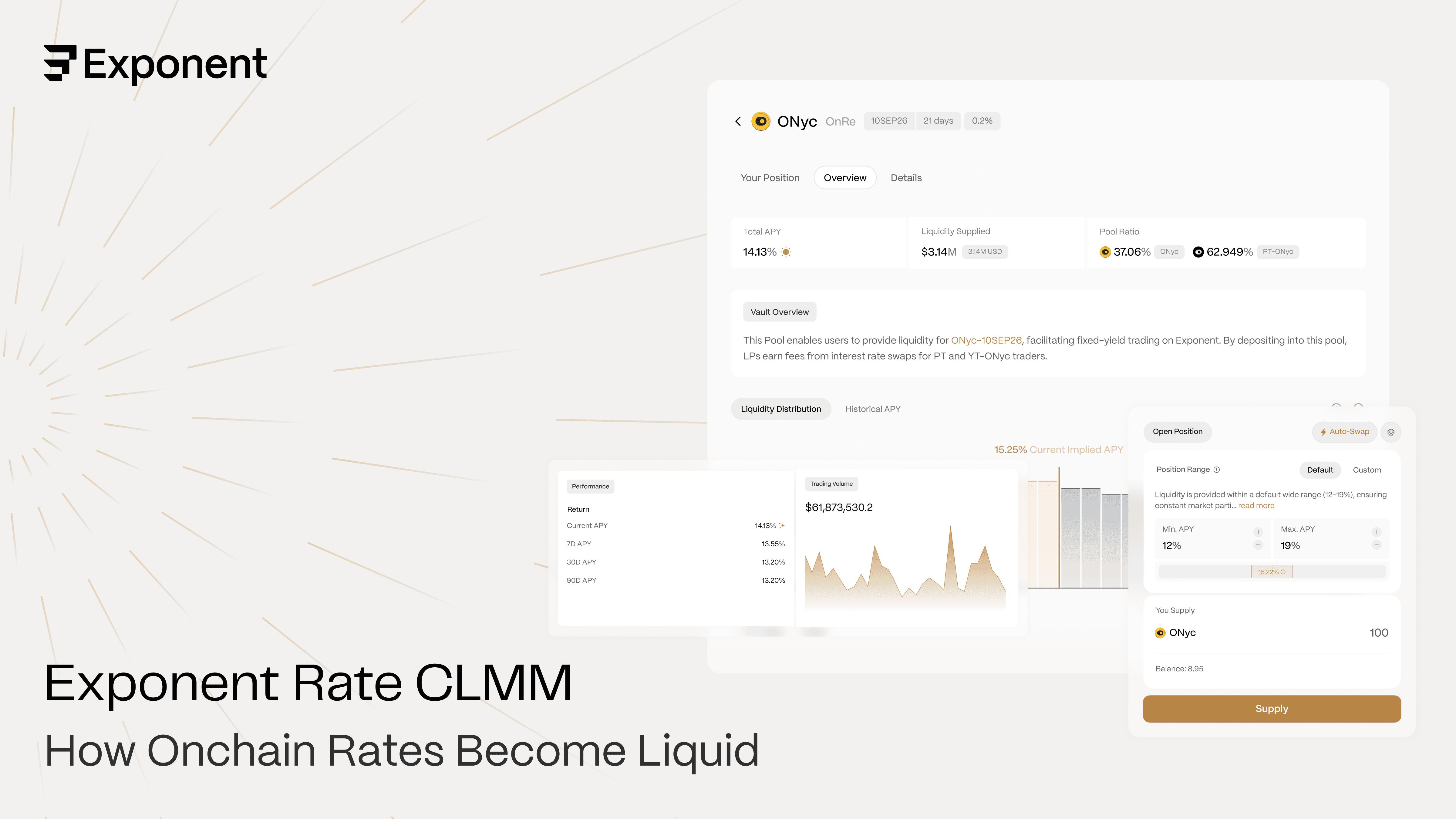
Markets are only as strong as the liquidity supporting them. In traditional finance, few run deeper than interest rates, underpinning everything from mortgages and sovereign debt to corporate credit. They function reliably because professional liquidity stands ready on both sides of every trade, a role typically reserved for a narrow set of qualified institutions.
Onchain liquidity is built on the same principles, on rails open to anyone. It has also evolved quickly: order books gave way to Automated Market Makers (AMMs), and AMMs gave way to concentrated liquidity, each step deepening markets with the same amount of capital. But every one of those steps was designed for markets that trade on price. Rates behave differently, and market making them well takes infrastructure built around how they move.
This is where the Exponent Rate Concentrated Liquidity Market Maker (rCLMM), a key launch of Exponent v2, comes in. It deploys liquidity against onchain rates themselves, turning liquidity provision into a strategy any participant can shape around their own portfolio.
How Trading on Exponent Works
Exponent splits a yield asset into two tradeable components: Principal Tokens (PT), which redeem for the underlying asset at maturity and carry a fixed rate, and Yield Tokens (YT), which capture all the variable yield the asset generates until maturity.
That split turns yield into something you can trade:
Swapping into PT locks in a fixed rate, effectively shorting the yield and buying rate certainty.
Swapping into YT amplifies exposure to the variable yield, effectively longing the rate.
Every position on Exponent is, at its core, a view on where a rate is heading.
Exponent offers two venues for expressing that view. The Rate Order Book provides precise execution at target rates through Rate Limit Orders, and works alongside the rCLMM, which provides continuous liquidity across rate ranges so every trade has a counterparty at all times. Together they make Exponent host the largest rate markets on Solana.
What Is Concentrated Liquidity
Classic AMMs spread liquidity across every possible price, from zero to infinity, even though most assets trade within a predictable range. Most of that capital sits idle at prices that never trade, which means growing a market depends on attracting more deposits rather than making better use of the ones already there.
Concentrated liquidity lets providers deploy capital into a select range where they expect trading to happen. The same capital absorbs larger orders with less price impact, and markets become deeper without requiring more deposits.
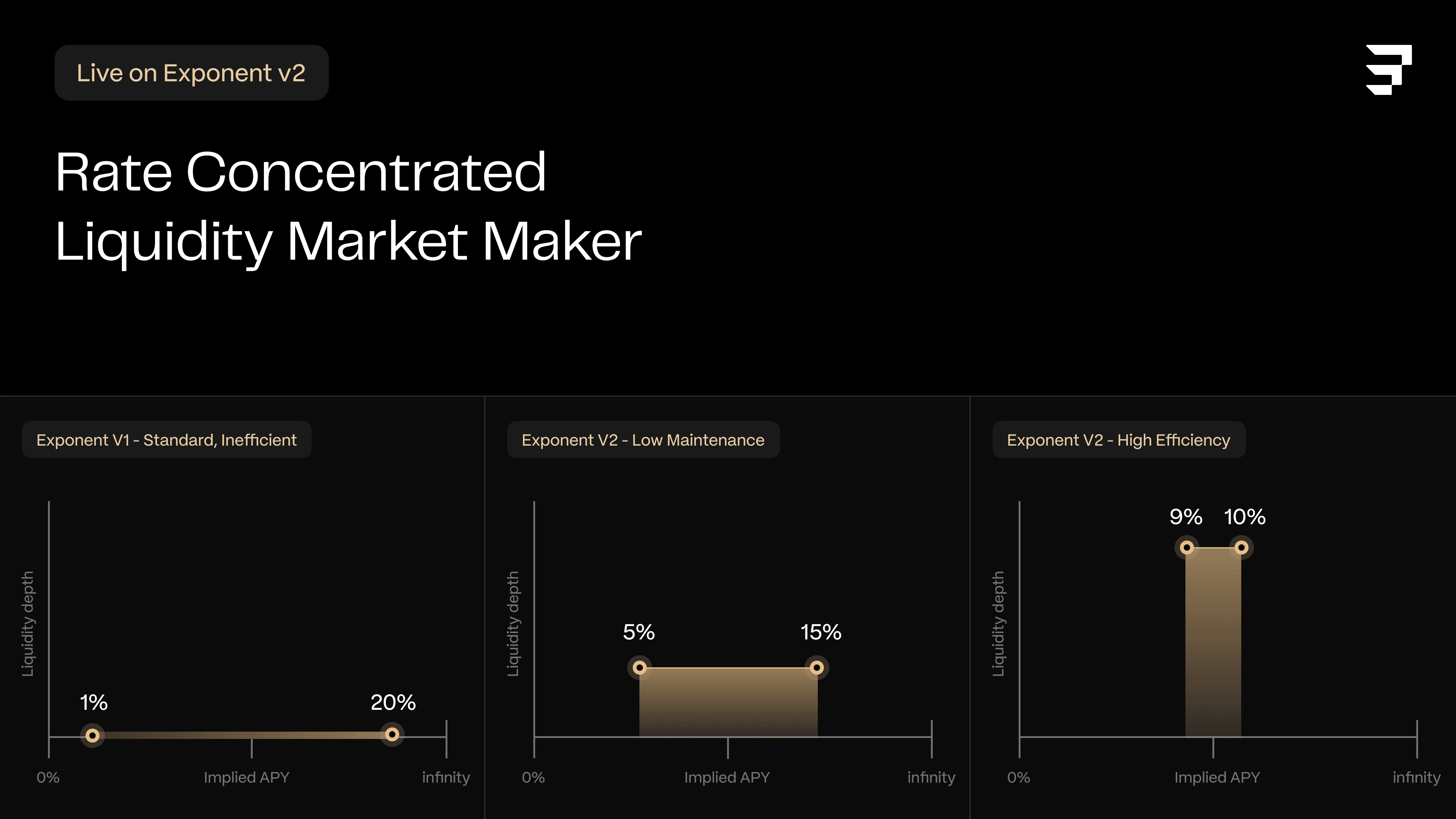
It also breaks the one-size-fits-all model of liquidity provision: instead of a single passive profile, providers choose between wide, low-maintenance ranges and narrow, high-efficiency ones, matching their position to how actively they want to manage it.
Rate markets fit this logic best. Concentrated liquidity rewards providers for choosing the right range, and rate ranges are far easier to predict than price ranges. There is no ceiling on what the market will price an asset at, while there is a predictable range for what an asset can produce, even when it carries speculative points incentives.
Rates also settle at a known value when Principal Tokens redeem at par, giving providers a fixed endpoint to range around. Adapted for rate markets, concentrated liquidity shows what the design is capable of.
How the Exponent Rate CLMM Works
Where conventional CLMMs concentrate liquidity around the price of a token pair, the Exponent rCLMM concentrates liquidity around the rate itself.
Liquidity providers choose the implied APY range their capital covers, for example between 15% and 17% on a given asset. Their capital is active whenever the market rate trades inside that range, earning fees on every trade, and idle when the rate moves outside it. Every range is a rate view, shaped around the provider's targets for returns and active management overhead.
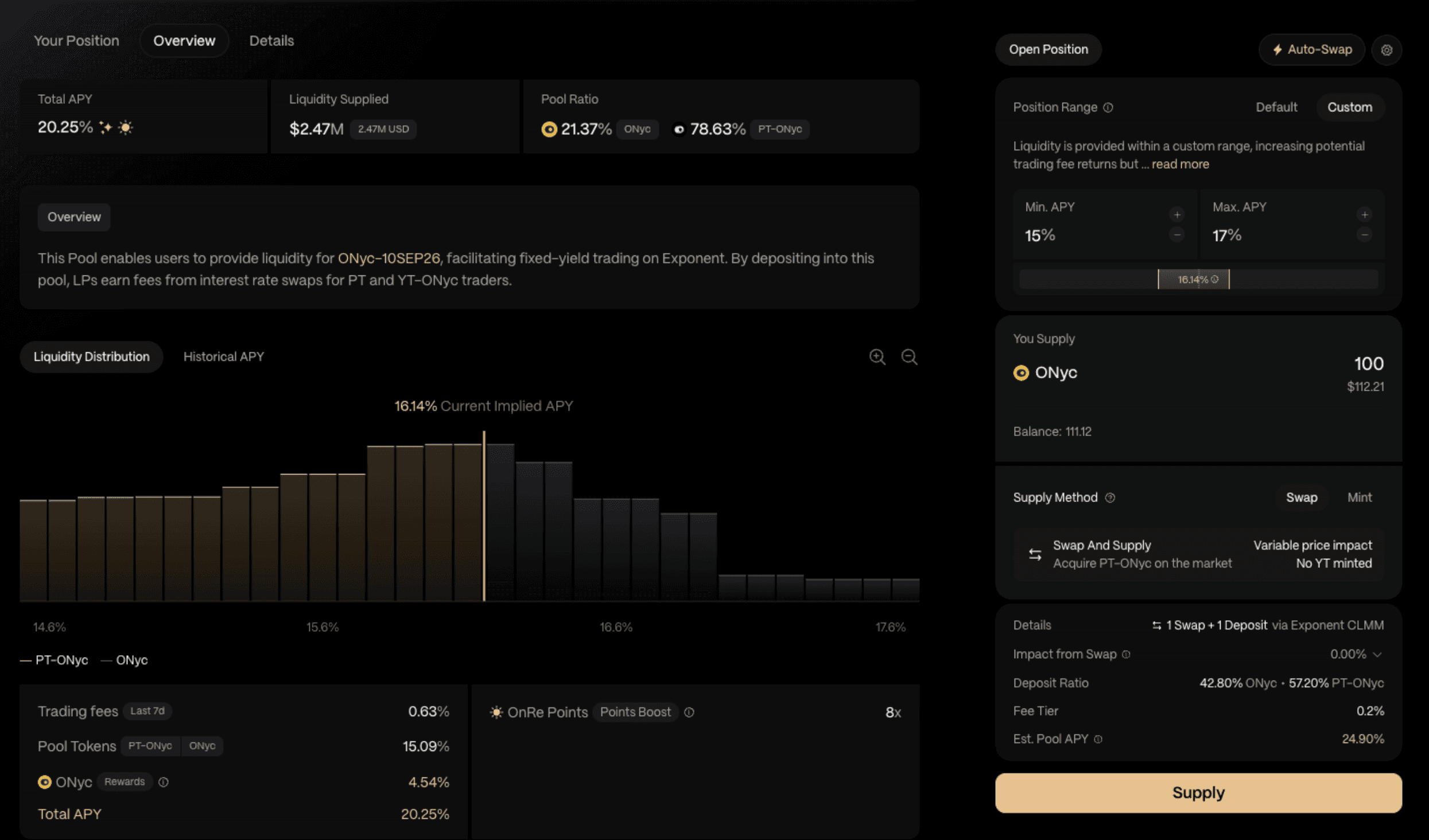
Every CLMM position holds two assets:
Principal Tokens (PT), the fixed-rate side of the market,
and SY, the standardized form of the yield-bearing asset itself.
In the ONyc market, for example, a position holds PT-ONyc and ONyc. Yield Token (YT) trades route through the same pool via flash swaps, stripping or merging PT and YT atomically within a single transaction, so a single liquidity position earns fees from both fixed and variable rate trading flow.
Supplying Liquidity: Two Paths In
To open a position, liquidity providers deposit the underlying asset and choose one of two supply modes.
Swap & Supply takes the direct route. A portion of the deposit is swapped for PT on the market, and the combined position is supplied within the chosen rate range. It is the simplest path in, holding a single position with nothing else to manage, and suits deposits that are small relative to existing liquidity, since the swap incurs price impact.
Mint & Supply avoids the swap entirely. The deposit mints PT directly at zero price impact, with YT minted as a byproduct and sent to the provider's wallet. The PT enters the liquidity position while the YT keeps the provider exposed to the underlying yield, and can be held, sold, or merged with PT later to recover the underlying. This is the natural path for larger deposits, or in the early life of a market where a swap would move the rate against the provider's own position.
What Providers Earn
Returns on an rCLMM position gather from four sources:
Trading fees from every PT and YT swap executed within the position's range
The PT side of the position accruing toward full value as maturity approaches
The underlying asset continuing to earn its base yield inside the position
Farm emissions and incentive programs, when active on the market
And because the pool pairs two correlated assets, impermanent loss is significantly lower than in standard AMM pairs. Held to maturity, when all PT redeems at par, impermanent loss is effectively zero.
Exponent v2 rCLMM vs Exponent v1 AMM
To see what concentration changes in practice, compare the same market on Exponent v1's AMM and the Exponent v2 rCLMM.
On the Exponent v1 AMM, liquidity spreads across the full curve, covering rates from 0% to infinity regardless of where the market actually trades.
On the Exponent v2 rCLMM, providers choose their own coverage: a wide 5% to 15% range for passive, low-maintenance exposure, or a tight 9% to 10% band concentrated on the trading rate.
Modeled on the ONyc market as it stood on August 19th, 2026, with implied APY at 15.25%, the difference is evident. A $1M purchase of PT would pull the rate down 3.13 percentage points on the v1 AMM against 2.48 points on the rCLMM. Selling $1M notional would push it up 3.42 points on v1 against 1.69 on the rCLMM.
The rCLMM held $3.47M at the time to v1's $5.37M. Roughly a third less capital, absorbing the same order with 21% less rate movement on the buy side and 51% less on the sell side.
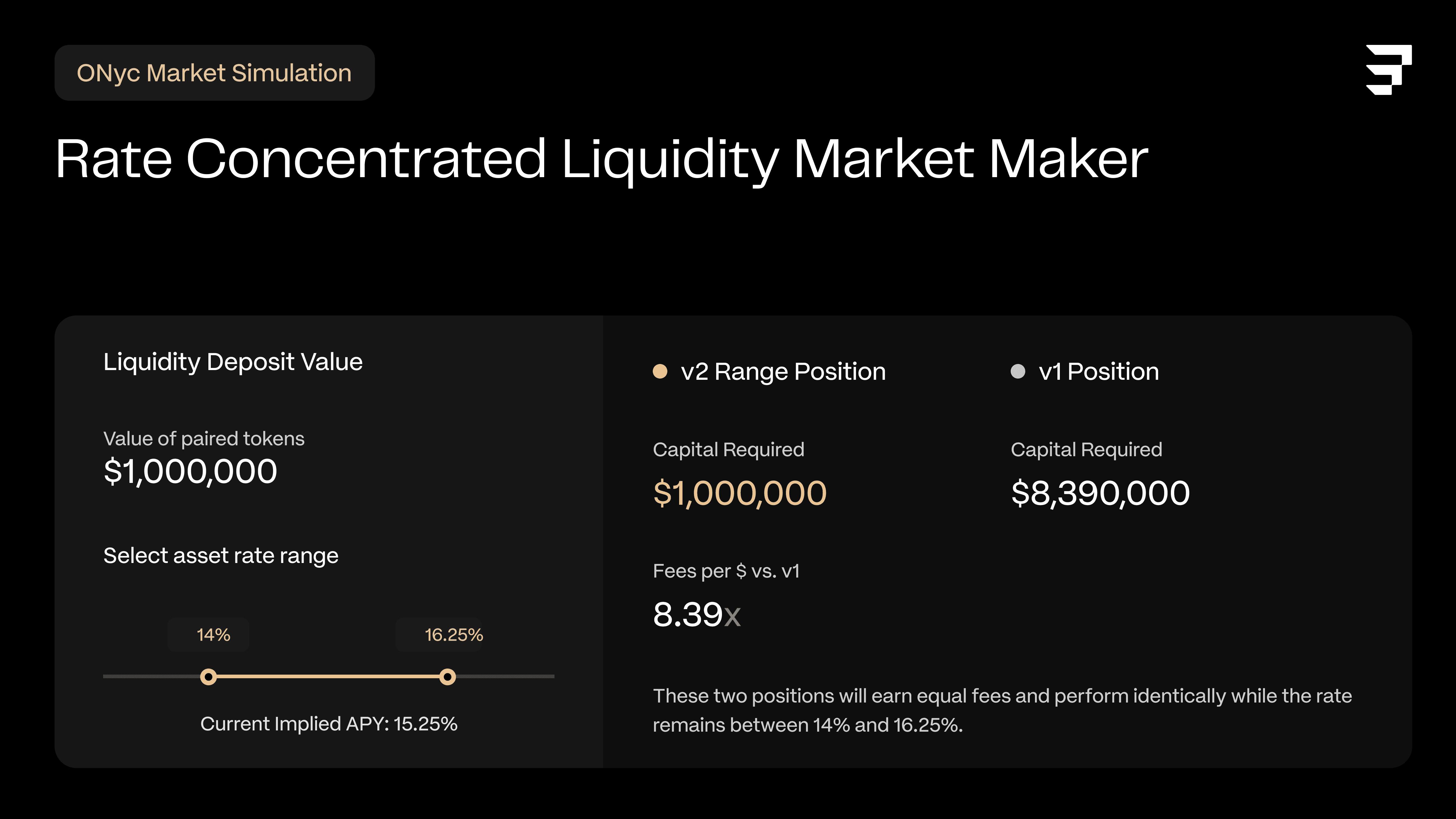
Concentration compounds for providers. On the same ONyc market, $1M concentrated between 14% and 16.25% provides the depth a v1 position would need $8.39M to match. Both capture the same trading flow, so the concentrated position earns 8.39 times the fees per dollar deployed.
That holds only while the rate sits inside the range. Once implied APY moves outside it, the capital stops quoting, which is why the tighter band asks for more frequent repositioning. In practice providers manage this well as 97.9% of rCLMM inventory on ONyc was active at the time of the snapshot.
Who Should Consider Market Making Rate Markets
Rate concentration opens liquidity provision to a full spectrum of participants, from majority passive to professionally active.
Everyday users diversify their portfolio with a wide, low-maintenance range or a tighter, more active one, adding trading fees to the underlying asset exposure they already have.
Yield and rewards seekers use Mint & Supply to keep YT exposure to the underlying yield and points programs, while their PT earns trading fees inside the pool.
Rate traders with a view deploy narrow ranges above or below the current rate, creating positions that act like resting orders and turn a directional rate view into fee income.
Treasuries and funds holding yield-bearing assets supplement their returns by adding fee income to the native yield those assets already generate.
Curators and professional managers add liquidity provisioning to their strategies, bootstrap new markets, or build a Strategy Vault that combines rCLMM positions with other strategies into a single managed product.
Asset issuers bootstrap deep liquidity for a new yield asset across a wide rate range, making the market tradable from day one and establishing presence for their asset's rate markets.
Professional market makers quote directly in rate terms, the same unit their books, hedges, and risk limits already run in. On a price-based pool, a fixed range drifts to a different rate every day as maturity approaches, forcing constant rebalancing just to hold the same view. On the rCLMM, a range holds its meaning until maturity.
Liquidity as the Foundation of Growing Onchain Rates
Rate markets are where onchain finance is maturing fastest. New LSTs, RWAs, and yield-bearing tokens come to market every week, each with a rate to be traded, hedged, and made liquid.
The rCLMM is the infrastructure that makes those markets deep enough to matter. It gives traders the depth to size fixed or variable rate exposure to their risk profile, liquidity providers a way to shape a strategy around their own portfolio, and every new yield asset a path to liquid, tradeable rates from day one.
Concentrated liquidity made onchain markets efficient. The Exponent rCLMM does the same for rates.
Explore Exponent's rate markets and start providing liquidity today: app.exponent.finance/liquidity
Markets are only as strong as the liquidity supporting them. In traditional finance, few run deeper than interest rates, underpinning everything from mortgages and sovereign debt to corporate credit. They function reliably because professional liquidity stands ready on both sides of every trade, a role typically reserved for a narrow set of qualified institutions.
Onchain liquidity is built on the same principles, on rails open to anyone. It has also evolved quickly: order books gave way to Automated Market Makers (AMMs), and AMMs gave way to concentrated liquidity, each step deepening markets with the same amount of capital. But every one of those steps was designed for markets that trade on price. Rates behave differently, and market making them well takes infrastructure built around how they move.
This is where the Exponent Rate Concentrated Liquidity Market Maker (rCLMM), a key launch of Exponent v2, comes in. It deploys liquidity against onchain rates themselves, turning liquidity provision into a strategy any participant can shape around their own portfolio.
How Trading on Exponent Works
Exponent splits a yield asset into two tradeable components: Principal Tokens (PT), which redeem for the underlying asset at maturity and carry a fixed rate, and Yield Tokens (YT), which capture all the variable yield the asset generates until maturity.
That split turns yield into something you can trade:
Swapping into PT locks in a fixed rate, effectively shorting the yield and buying rate certainty.
Swapping into YT amplifies exposure to the variable yield, effectively longing the rate.
Every position on Exponent is, at its core, a view on where a rate is heading.
Exponent offers two venues for expressing that view. The Rate Order Book provides precise execution at target rates through Rate Limit Orders, and works alongside the rCLMM, which provides continuous liquidity across rate ranges so every trade has a counterparty at all times. Together they make Exponent host the largest rate markets on Solana.
What Is Concentrated Liquidity
Classic AMMs spread liquidity across every possible price, from zero to infinity, even though most assets trade within a predictable range. Most of that capital sits idle at prices that never trade, which means growing a market depends on attracting more deposits rather than making better use of the ones already there.
Concentrated liquidity lets providers deploy capital into a select range where they expect trading to happen. The same capital absorbs larger orders with less price impact, and markets become deeper without requiring more deposits.
It also breaks the one-size-fits-all model of liquidity provision: instead of a single passive profile, providers choose between wide, low-maintenance ranges and narrow, high-efficiency ones, matching their position to how actively they want to manage it.
Rate markets fit this logic best. Concentrated liquidity rewards providers for choosing the right range, and rate ranges are far easier to predict than price ranges. There is no ceiling on what the market will price an asset at, while there is a predictable range for what an asset can produce, even when it carries speculative points incentives.
Rates also settle at a known value when Principal Tokens redeem at par, giving providers a fixed endpoint to range around. Adapted for rate markets, concentrated liquidity shows what the design is capable of.
How the Exponent Rate CLMM Works
Where conventional CLMMs concentrate liquidity around the price of a token pair, the Exponent rCLMM concentrates liquidity around the rate itself.
Liquidity providers choose the implied APY range their capital covers, for example between 15% and 17% on a given asset. Their capital is active whenever the market rate trades inside that range, earning fees on every trade, and idle when the rate moves outside it. Every range is a rate view, shaped around the provider's targets for returns and active management overhead.
Every CLMM position holds two assets:
Principal Tokens (PT), the fixed-rate side of the market,
and SY, the standardized form of the yield-bearing asset itself.
In the ONyc market, for example, a position holds PT-ONyc and ONyc. Yield Token (YT) trades route through the same pool via flash swaps, stripping or merging PT and YT atomically within a single transaction, so a single liquidity position earns fees from both fixed and variable rate trading flow.
Supplying Liquidity: Two Paths In
To open a position, liquidity providers deposit the underlying asset and choose one of two supply modes.
Swap & Supply takes the direct route. A portion of the deposit is swapped for PT on the market, and the combined position is supplied within the chosen rate range. It is the simplest path in, holding a single position with nothing else to manage, and suits deposits that are small relative to existing liquidity, since the swap incurs price impact.
Mint & Supply avoids the swap entirely. The deposit mints PT directly at zero price impact, with YT minted as a byproduct and sent to the provider's wallet. The PT enters the liquidity position while the YT keeps the provider exposed to the underlying yield, and can be held, sold, or merged with PT later to recover the underlying. This is the natural path for larger deposits, or in the early life of a market where a swap would move the rate against the provider's own position.
What Providers Earn
Returns on an rCLMM position gather from four sources:
Trading fees from every PT and YT swap executed within the position's range
The PT side of the position accruing toward full value as maturity approaches
The underlying asset continuing to earn its base yield inside the position
Farm emissions and incentive programs, when active on the market
And because the pool pairs two correlated assets, impermanent loss is significantly lower than in standard AMM pairs. Held to maturity, when all PT redeems at par, impermanent loss is effectively zero.
Exponent v2 rCLMM vs Exponent v1 AMM
To see what concentration changes in practice, compare the same market on Exponent v1's AMM and the Exponent v2 rCLMM.
On the Exponent v1 AMM, liquidity spreads across the full curve, covering rates from 0% to infinity regardless of where the market actually trades.
On the Exponent v2 rCLMM, providers choose their own coverage: a wide 5% to 15% range for passive, low-maintenance exposure, or a tight 9% to 10% band concentrated on the trading rate.
Modeled on the ONyc market as it stood on August 19th, 2026, with implied APY at 15.25%, the difference is evident. A $1M purchase of PT would pull the rate down 3.13 percentage points on the v1 AMM against 2.48 points on the rCLMM. Selling $1M notional would push it up 3.42 points on v1 against 1.69 on the rCLMM.
The rCLMM held $3.47M at the time to v1's $5.37M. Roughly a third less capital, absorbing the same order with 21% less rate movement on the buy side and 51% less on the sell side.
Concentration compounds for providers. On the same ONyc market, $1M concentrated between 14% and 16.25% provides the depth a v1 position would need $8.39M to match. Both capture the same trading flow, so the concentrated position earns 8.39 times the fees per dollar deployed.
That holds only while the rate sits inside the range. Once implied APY moves outside it, the capital stops quoting, which is why the tighter band asks for more frequent repositioning. In practice providers manage this well as 97.9% of rCLMM inventory on ONyc was active at the time of the snapshot.
Who Should Consider Market Making Rate Markets
Rate concentration opens liquidity provision to a full spectrum of participants, from majority passive to professionally active.
Everyday users diversify their portfolio with a wide, low-maintenance range or a tighter, more active one, adding trading fees to the underlying asset exposure they already have.
Yield and rewards seekers use Mint & Supply to keep YT exposure to the underlying yield and points programs, while their PT earns trading fees inside the pool.
Rate traders with a view deploy narrow ranges above or below the current rate, creating positions that act like resting orders and turn a directional rate view into fee income.
Treasuries and funds holding yield-bearing assets supplement their returns by adding fee income to the native yield those assets already generate.
Curators and professional managers add liquidity provisioning to their strategies, bootstrap new markets, or build a Strategy Vault that combines rCLMM positions with other strategies into a single managed product.
Asset issuers bootstrap deep liquidity for a new yield asset across a wide rate range, making the market tradable from day one and establishing presence for their asset's rate markets.
Professional market makers quote directly in rate terms, the same unit their books, hedges, and risk limits already run in. On a price-based pool, a fixed range drifts to a different rate every day as maturity approaches, forcing constant rebalancing just to hold the same view. On the rCLMM, a range holds its meaning until maturity.
Liquidity as the Foundation of Growing Onchain Rates
Rate markets are where onchain finance is maturing fastest. New LSTs, RWAs, and yield-bearing tokens come to market every week, each with a rate to be traded, hedged, and made liquid.
The rCLMM is the infrastructure that makes those markets deep enough to matter. It gives traders the depth to size fixed or variable rate exposure to their risk profile, liquidity providers a way to shape a strategy around their own portfolio, and every new yield asset a path to liquid, tradeable rates from day one.
Concentrated liquidity made onchain markets efficient. The Exponent rCLMM does the same for rates.
Explore Exponent's rate markets and start providing liquidity today: app.exponent.finance/liquidity

